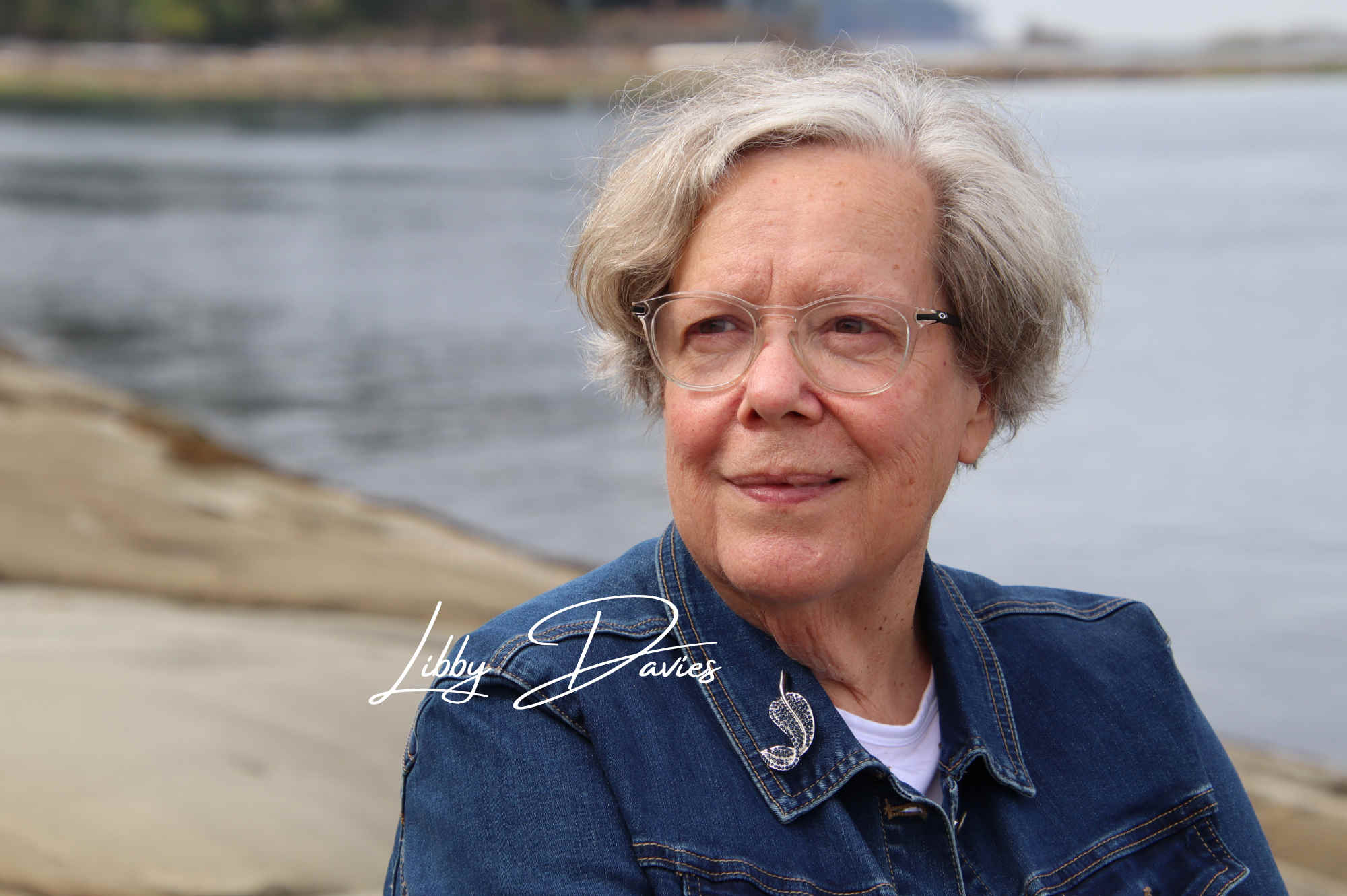
Libby Davies recounts four decades of political activism in her book Outside In: A Political Memoir
Libby Davies recounts four decades of political activism in her book Outside In: A Political Memoir
Orginally published in The Globe and Mail, May 21, 2019. By Andrea Woo.
Libby Davies built a career on going to bat for those who live on the margins: sex workers, people who use drugs, the poor, and members of the LGBTQ community. She served as NDP MP for Vancouver East from 1997 to 2015 and, before that, a city councillor under the Coalition of Progressive Electors banner from 1982 to 1993. She was also a founding member of the Downtown Eastside Residents Association, which fought for the neighbourhood’s most vulnerable residents.
Ms. Davies recounts four decades of political activism in her new book, Outside In: A Political Memoir, which launches in Vancouver Wednesday with an event at the SFU Goldcorp Centre for the Arts. The Globe and Mail spoke with Ms. Davies on progress made, and the road ahead.
Throughout your career, you took on issues that were not seen as mainstream, and indeed sometimes controversial. Were you ever concerned that taking such stands would cost you politically?
Oh, yeah. I remember my first campaign manager, Glen Sanford, said “Libby, Libby, be careful,” and other people saying to me, “You’re not going to get re-elected.” This was in 1998, when the battle to open Insite, the safe injection site, was going on. We would get a deluge of e-mails in our office from local residents who were like, “Get these people out of here. Lock them up. What are you doing?” It was absolutely my connection with people like [late Downtown Eastside poet and community organizer] Bud Osborn, and the Vancouver Area Network of Drug Users, and others in the Downtown Eastside, that kept me on that path. I’ve always felt that was my role in politics, to take on these issues that were not mainstream.
In Ontario, supervised drug-use sites have been hit with funding cuts and additional red tape that challenge their very existence. What advice do you have for the community organizers, activists and politicians currently navigating that landscape?
You absolutely have to keep at it. And I think you have to humanize the issue. It’s so easy to say, “It’s their problem, it’s a burden on society.” We have to tell the stories of people who are facing addiction, who are trying to survive every single day. The other thing is that you have to find, what I call in the book, unusual allies. In our situation in Vancouver, I remember an extraordinary meeting when Bud and I met with parents in Kerrisdale, whose kids were suffering from heroin overdoses. That was a very powerful alliance. Obviously, there is the scientific community – the doctors and the evidence – but the Doug Fords of the world, they don’t really care about evidence. For them, this is an ideological issue and that’s what we faced with Stephen Harper for a decade. I think it’s a matter of finding broad alliances and making it clear that this is about saving lives.
In your memoirs, you write of your frustration over the NDP not taking a clear stand on cannabis legalization. Tell me about the process of coming up with party lines, and your feelings going through it.
I did feel frustrated because there were a number of us in caucus who wanted to come out with a very clear stance around what we called a regulatory approach. We sort of got there – I tabled a resolution in the House that laid out what the NDP would do – but the language wasn’t strong enough, and [Prime Minister Justin] Trudeau had already gone out on it. I felt it was a missed opportunity. We weren’t clear what we wanted to do. And there were people who worried it was a niche thing, and it would be an opportunity for the conservatives to go at us. But of course, it’s a very broad issue and most people in Canada recognize that criminalizing people for marijuana and other drug use is a totally failed response.
What are your thoughts on how the roll-out of cannabis legalization has gone so far?
I think it’s been difficult. I truly worry about the corporate nature of the legalization of marijuana. It is just horrifying to me that some of the politicians who were so against harm reduction, who were so against any kind of drug policy reform, are now jumping on a corporate bandwagon because they see huge profits. I find it personally disturbing, unethical. I always advocated more for kind of a community-based approach. I feel like the Liberals have sort of driven it into this very high-stakes business model, and they’ve really shut out the mom-and-pop operations, the more community-based, cooperative operations.
Was there anything else that you wanted to add?
One of the reasons I wrote the book was because I wanted to try and get past the cynicism that people have about politics. I wanted to make it clear that change happens when people are engaged. If we don’t get involved ourselves, we are giving more power to the people who already have it. I wanted to share my experiences about that and give people a sense that when we engage, we can work for transformative change by supporting each other, by working with each other, not being so hyper-partisan and, particularly on the left, not being so critical of each other.
Libby’s letter to Prime Minister on Gaza
Libby’s letter to Prime Minister on Gaza
January 6, 2009
Right Honourable Stephen Harper
House of Commons
Ottawa, Ontario K1A 0A6
Dear Prime Minister,
The top UN official in Gaza has reported that “nowhere is safe in Gaza.” With a mounting death toll of over 600 Palestinians; over 2,700 wounded; and an unfolding humanitarian crisis of no running water, no electricity, no adequate medical help, and 13,000 refugees who have fled the front lines, the assault on Gaza by Israel will not in any way improve conditions for peace and security. Indeed it will only create greater instability and violence in the area.
An immediate ceasefire is imperative, to prevent an even greater disaster of human suffering and destruction. Such a ceasefire must include an end to the firing of rockets from Hamas into Israel.
The lack of leadership from the Canadian government is shameful in the face of such events.
Canada should be using all its efforts to work at the UN and in the international community, to bring about a ceasefire, to end the blockade, and to focus efforts on humanitarian aid and reconstruction in Gaza, plus a just peace process, as per previous UN resolutions.
I have received many messages from constituents who are outraged that Canada has done nothing.
We expect our government to uphold international law and work to stop this aggression by one state upon another. We must condemn all acts of violence, and use every available means for political, diplomatic, and peaceful resolutions.
I urge the Canadian government to speak out and no longer be apologetic for what is taking place.
Yours sincerely,
Libby Davies, MP (Vancouver East)
Cc:
Jack Layton, Leader, NDP
Paul Dewar, MP (Ottawa Centre), NDP Spokesperson for Foreign Affairs
Libby's letter to Prime Minister on Gaza
Libby's letter to Prime Minister on Gaza
Libby's letter to Prime Minister on Gaza
Libby's letter to Prime Minister on Gaza
Libby calls for answers in the extradition of Marc Emery
Libby calls for answers in the extradition of Marc Emery
Canada’s Prince of Pot finds great irony in his pending extradition south of the border. “They’re going to legalize marijuana in California, in Nevada, and much of the United States very soon,” Marc Emery noted in a phone interview with the Georgia Straight. “It’s quite possible I’ll be incarcerated even though I’m one of the people who provided the wherewithal for all these legalization movements to happen. I’ll be in jail being persecuted while they’re out, Americans are actually out, celebrating.”
The original article, Upbeat Marc Emery on way to jail was published on December 29, 2009 in The Georgia Straight. Author(s): Carlito Pablo