Politics
Podcast: CJSF 90.1 FM interview about Outside In
Podcast: CJSF 90.1 FM interview about Outside In
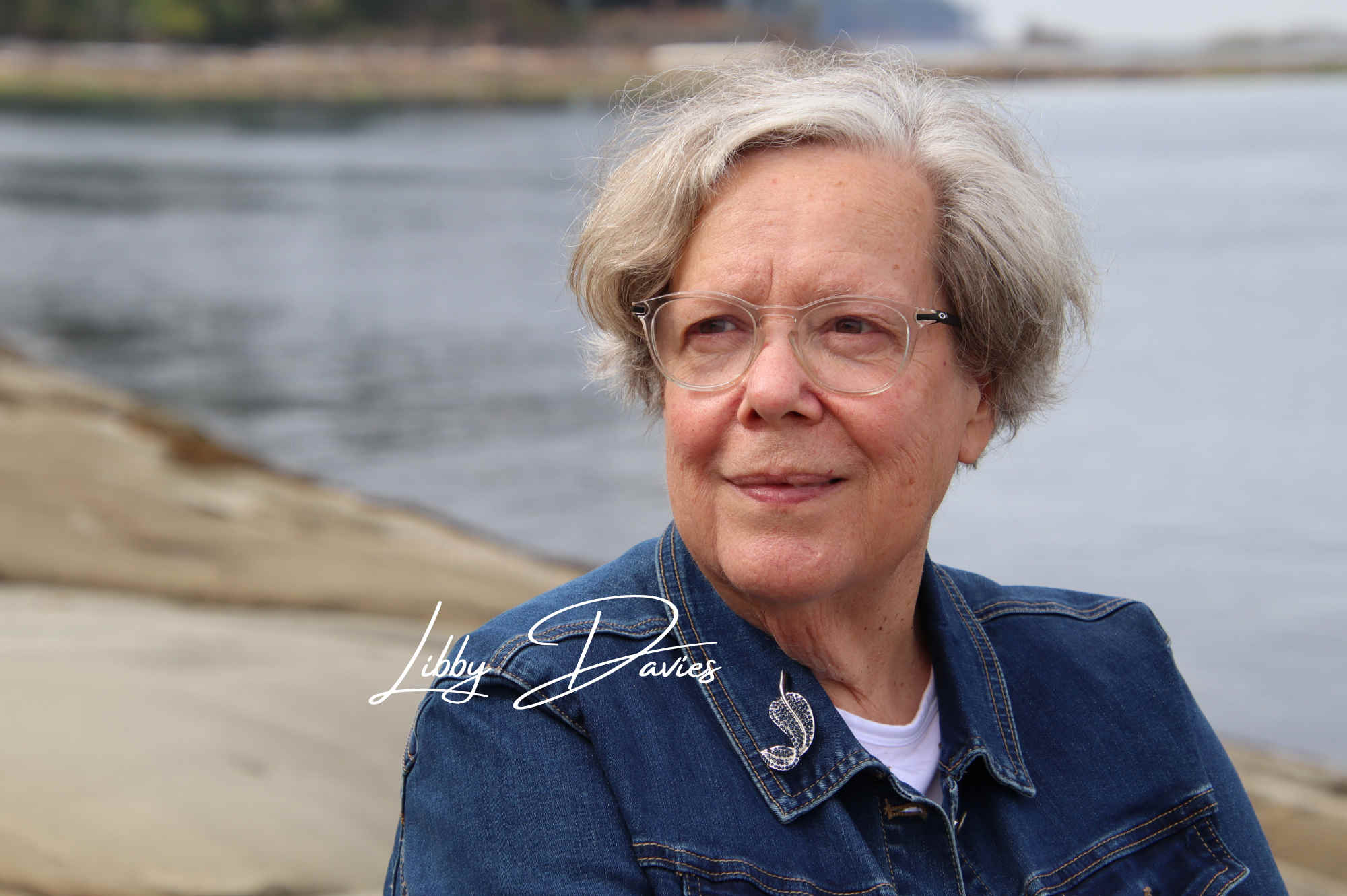
Part 1 of todays show features an interview with Libby Davies about her new book A Political Memoir: Outside In. Listen below.
The original article, Podcast: CJSF 90.1 FM interview about Outside In was published on in CJSF 90.1 FM. Author(s): Karen and Kiara
How an ‘unflinching gaze’ on missing and murdered Indigenous women might move Canada forward – Libby Davies
How an ‘unflinching gaze’ on missing and murdered Indigenous women might move Canada forward
The first use in the House of Commons of the phrase “missing and murdered” in reference to Aboriginal women was recorded on March 22, 2004, when Libby Davies reported that the Native Women’s Association of Canada (NWAC) was launching a new campaign, Sisters in Spirit, to raise awareness about what was believed to be 500 women who had disappeared or died.
The original article, How an ‘unflinching gaze’ on missing and murdered Indigenous women might move Canada forward was published on August 4, 2016 in CBC. Author(s): Aaron Wherry
February 2007
Libby speaks out to defend the rights of refugees
Libby speaks out to defend the rights of refugees
House of Commons
HANSARD
September 20, 2011
NOTE: This speech can also be viewed at http://www.youtube.com/user/LibbyDaviesMP?ob=5#p/a/u/1/SxRAmkeFSYY
Ms. Libby Davies (Vancouver East, NDP):
Mr. Speaker, I am pleased to rise in the House today to speak to Bill C-4, following many of my colleagues from the NDP who have pointed out the serious flaws and problems with the bill. Of course, we all remember the bill that was presented in the previous Parliament, Bill C-49.
I want to begin my remarks today by registering my concern about what I have seen over the years from the government. It seems to me that refugees have become scapegoats; they have become political footballs to target and, in many ways, to tarnish. The bill before us today, a continuation of Bill C-49, seeks to do that.
I have been listening to the debate today in the House and have heard Conservative members say that smugglers should be prosecuted to the full extent of the law and that this bill is about going after smugglers. However, as my colleagues have pointed out, in actual fact the bill really does not speak to that issue.
In reality, Parliament did pass a bill a few months ago dealing with refugees. The laws that we already have in place contain provisions ensuring a life sentence for human smuggling. This raises the serious question of why this legislation is coming forward and what its purpose is.
When the bill was originally introduced in the previous Parliament, many organizations, such as the Canadian Council for Refugees, Amnesty International Canada, the Canadian Civil Liberties Association, the Canadian Bar Association, and the Centre for Refugee Studies, examined the bill and in a thoughtful way pointed out its serious problems.
These organizations studied the issue, not from a partisan point of view but a neutral point of view, as to whether or not the proposed legislation would be harmful to our refugee process or would assist that process. All members of the House, and certainly the government, should be aware that the response to the bill was resoundingly negative by the organizations that work closely on the issue.
We in the NDP have significant concerns. We are concerned that the bill would basically allow two classes of refugee claimants. It would allow designated claimants to be detained mandatorily, including their children. I think it is very powerful that many members today have spoken of their feelings about this aspect alone. What would it mean to incarcerate and detain children or not allow family reunification? This is a serious problem with the bill.
I remember a few years ago, when another boat arrived off the coast of B.C. from Fujian province in China, dozens of claimants were detained. I remember visiting them in jail in Burnaby, British Columbia. I remember the incredible issues and concerns they had in terms of not having access to lawyers, not being able to make proper phone calls, not having culturally sensitive provisions and food, and being separated from their families. That was a few years ago, and this bill was not even in effect at that time. I remember delivering a series of letters by the detained women from Fujian province to the minister, imploring the minister to address their grievances and the situation they were facing in staying in jail for many months.
If the bill goes through, we will see a system set in place that would give enormous power to the minister. Notwithstanding any other provisions in the bill, this is something that we should be very worried about. We have seen so much legislation from the government that centralizes authority and power and decision-making and discretion with the minister. Why on earth would we undermine our system overall and confer such extraordinary powers on the minister to designate claimants and then, as a result, place them in detention? That alone is a serious problem with the bill.
Canada has had a reputation of being a fair and reasonable country in protecting refugees and their rights, providing settlement in this country and upholding international law. Yet many of us today, in expressing our thoughts and concerns about this bill, point to the fact that this bill itself may end up facing a charter challenge and that it may be in contravention of international treaties. This leads me to wonder why this bill has come forward.
Why are we targeting human smuggling in this fashion when we already have provisions in the law that deal with such smuggling? We already have provisions in a new refugee bill that produced a more balanced result. Why is this particular bill coming forward?
I have come to the conclusion, as I think have many others, that it is more about a political line or optic that the Conservative government wants to lay down. It is like their get tough on crime approach. It has nothing to do with dealing with real issues and complex situations; it has everything to do with laying down a very simplistic approach that gives more power to the minister and actually strips away the rights we have had for refugees in this country.
Another very problematic provision in the bill is the fact that designated claimants would be denied access to appeal. They could not make an application on humanitarian and compassionate grounds. These are all hallmarks of the system we have in place. They are actually provisions that we members of Parliament use. We hear from constituents who are often in very difficult situations, who have come from another country and are going through the process and who may end up making an application on humanitarian and compassion grounds to the minister. Yet here we have this bill that, all of a sudden, would not allow that to happen.
So it seems to me that this is a very serious step being taken. Here I would note that in the previous Parliament, the three opposition parties adamantly opposed the bill, and in fact the government did not bring it forward because it knew that the bill would likely be defeated by a majority in Parliament. Now we have a majority Conservative government, but that does not deter us from raising these significant points and alerting the public that, while the government might be fear-mongering and putting a political spin on this, the reality is that this is very bad legislation.
I want to thank the organizations that have taken the time to examine the bill thoroughly to give us their analysis to help us see the reality that this bill is very bad.
In today’s global world, it seems very ironic to me that we have a government hell-bent on allowing capital to move wherever it wants with no restraints. We have a government that has, at the top of its agenda, trade agreements that have virtually no restraints. So there is this idea of freedom of movement in the globalized world. Yet when it comes to people, the real resource in our world, humans and their capacity to produce and to live productive lives, we see this draconian legislation aimed at slamming people who may make very legitimate refugee claims in this country, who may be fleeing persecution and may have been taken advantage of and exploited.
There is no question that we need to focus on the problems that exist with human smuggling, but as I have pointed out, there are already very stiff provisions dealing with that aspect. This bill does not speak to that; this bill is targeted at the refugee claimants themselves. It is targeted at the people who are in that situation, if they arrive by boat. So this is bad legislation.
I am very proud that New Democrats are standing up against this legislation and pointing out the problems with it. I hope that if it does go to committee, we will have an opportunity to go through this bill in great detail, to make substantive changes and come to some recognition that the bill as is cannot go forward.
Why are both central and provincial/local governments necessary?
Why are both central and provincial/local governments necessary?
Why are both central and provincial/local governments necessary? Libby participated in the Canada instalment, of a five part educational video series, produced by Forum of Federations.
The original article, Why are both central and provincial/local governments necessary? was published on June 21, 2016 in Forum of Federations. Author(s): Karl Nerenberg
Statement on World AIDS Day 2014
November 2014
MP tries again to make anthem include Canada’s daughters – Libby Davies
MP tries again to make anthem include Canada’s daughters
Mauril Belanger’s private members’ bill proposes to change the second line of the anthem from “True patriot love in all thy sons command” to “True patriot love in all of us command.”The lyrics as they are currently written exclude women and are therefore out of date, Belanger said. This is the fifth legislative attempt to change the lyrics since 2002, and the second by Belanger. His previous attempt fell short when his bill was defeated on second reading a year ago. In 2010, former Prime Minister Stephen Harper included a plan to change the lyrics of the national anthem in the Speech from the Throne to make it gender neutral. The plan was met with such a swift backlash Harper’s office backed down within two days. NDP Leader Tom Mulcair did not support the idea then, but a year later, NDP deputy leader Libby Davies introduced a private members’ bill that would have changed the lyrics.
The original article, MP tries again to make anthem include Canada’s daughters was published on May 6, 2016 in Winnipeg Free Press. Author(s): Mia Rabson