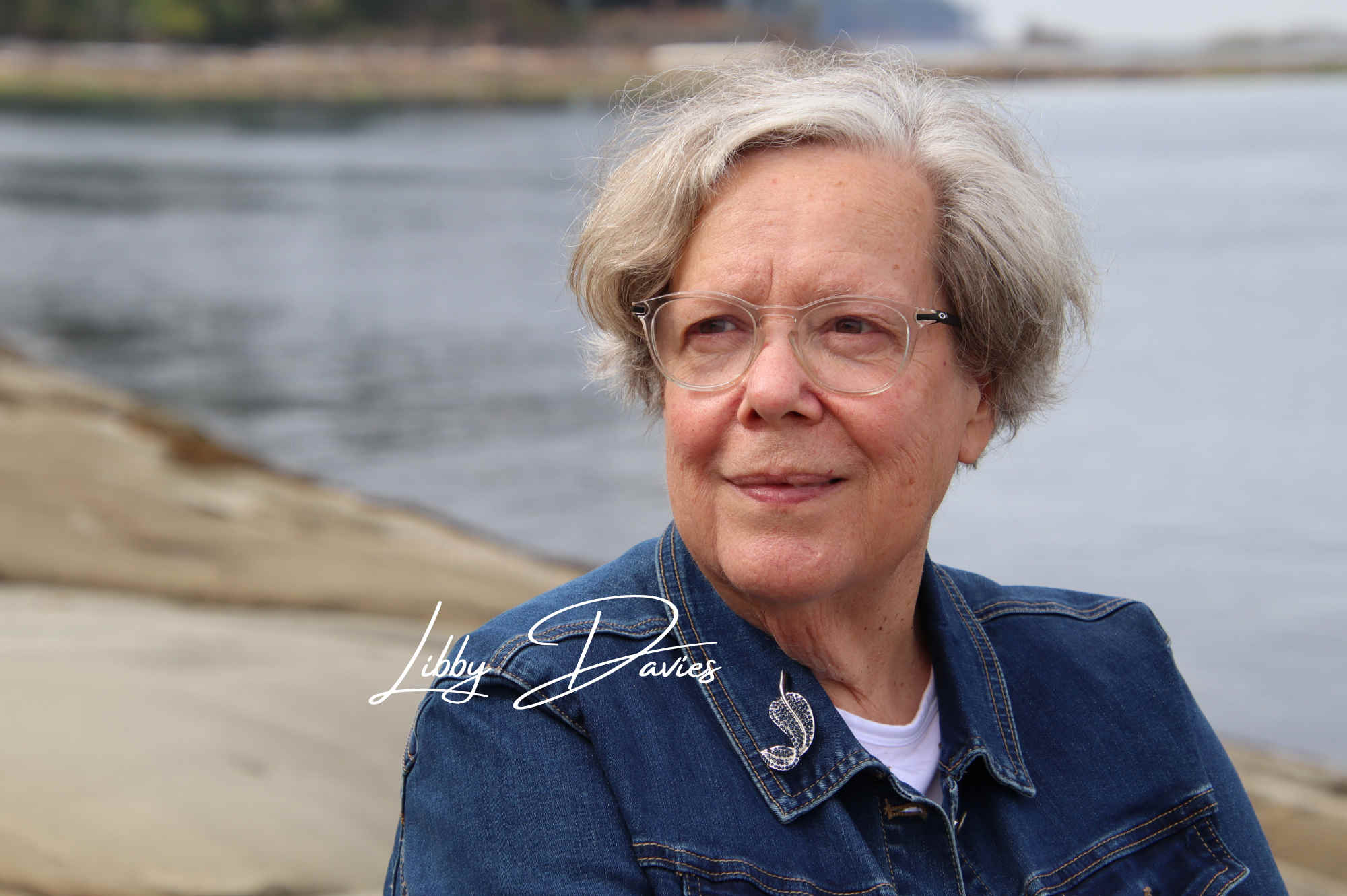
Libby speaks up for the rights of refugees
Libby speaks up for the rights of refugees
[[{“type”:”media”,”view_mode”:”media_large”,”fid”:”155″,”attributes”:{“alt”:””,”class”:”media-image”,”typeof”:”foaf:Image”}}]]
House of Commons
HANSARD
April 23, 2012
Ms. Libby Davies (Vancouver East, NDP):
Mr. Speaker, I have spoken on this bill before, but we are now debating a reasoned amendment at second reading. I want to thank my colleague for Vancouver-Kingsway for putting forward the motion that we are now debating that would eliminate many of the very offensive provisions of this bill.
I listened to the government member who spoke before me. Obviously the government is feeling frustrated that yet again it cannot get one of its bills through. It brings in closure and tries to shut down debate. On this particular bill, as with many other bills that we have seen, the concern in the broader community is unbelievable.
I was in my riding over the last couple of weeks, as I know many members were. I heard from people time and again, particularly those working in the refugee settlement system assisting refugees, how worried they are about the bill and the fact that it is going through Parliament. I want to reflect how bad people think this bill is.
I am glad that we are having this debate and that the member for Vancouver-Kingsway put forward his motion. It gives us another opportunity to try to expose the grievous flaws in this bill. The bill would hurt people and tarnish Canada’s reputation as a place of refuge for refugees. In effect, it would create a two-tier refugee system and that is something we should be very concerned about.
I want to express concern about the discretion that the bill would give to the minister. I heard the minister earlier in his remarks saying that is not true and not something that would happen. However, when one reads it, this is clearly a strong element of the bill. Again, it is a trend that we have seen with the Conservative government. It tends to centralize more and more power in a minister’s hands and take away power from experts, panels and the system itself. It raises enormous suspicion among Canadians about the political motivation of the government with this kind of legislation.
We have a specific concern that the bill would make it easier to terminate refugee protection. I was astounded to learn that even once individuals became permanent residents they could have that taken away from them after the fact if conditions changed in their country of origin. This would create incredible uncertainty for refugees who had gone through the process and become permanent residents. In fact, it may even contravene international norms on the treatment of refugees. This is very concerning.
We have already had some debate and discussion on the clause that would prohibit refugee claimants who have been incarcerated in their home country for over 10 years and would not allow for tribunal discretion in the case of political prisoners. I heard the member give an example. What about someone like Nelson Mandela who is now an honorary citizen of Canada? Under the proposed system, he would not have been allowed in Canada. This very broad brush being cast over the system would deny unique and important circumstances of people who have been under political persecution to get the kind of protection they need. This leads me to wonder about the motivation behind a number of these bills.
I hear Conservative members time and again focus on the word “abuse”. It seems to me, whether it is the drug bills, bills under the criminal justice system or Bill C-31, they focus on a number of issues around abuse, make out that it is the norm and then penalize the whole system. They basically take a very hard-line approach on the whole system which penalizes legitimate claimants. I think this is very wrong. It is a pattern that has been emerging with the Conservative government in more and more legislation that has come before the House.
One of the areas of most concern in the bill is the changes to humanitarian and compassionate consideration. I know many of us, in our local constituencies, assist with casework for refugees. In my riding of Vancouver East, my staff and office work very hard. Over the years we have had hundreds of cases in which we have helped claimants with humanitarian and compassionate grounds. It is a very important element of the process.
The fact is the changes being contemplated in the bill mean that while claimants are waiting for an Immigration & Refugee Board decision, they cannot apply for humanitarian and compassionate grounds concurrently. That means claimants have to make a very difficult decision at the beginning as to whether they want to file for refugee status or humanitarian and compassionate consideration. We know that failed refugee claimants cannot apply for humanitarian and compassionate grounds for one year following a negative decision and possibly, by that time, they may have been deported.
Why is this important? I know from the casework we have done in our community that many people can have a refugee claim denied, but nonetheless may have a legitimate claim on humanitarian and compassionate grounds. Our belief is that a failed refugee claim should not get in the way of humanitarian and compassionate consideration.
This change in the act will make it more and more difficult and onerous for refugee claimants to actually have options before them, which they now have. It is definitely a hardening of the system. It is a narrowing of the criteria. It is a focus on abuse that now applies system-wide and makes it much more difficult for people.
As a result of these changes, if they do go through, members of Parliament are going to find it very difficult to work with claimants in our local communities and we are going to see a lot of hardship. We are going to see people facing a system that has closed down on them. I am very worried and concerned about the impact the bill will have.
Another concern with the bill is the fact that the minister will have the power to designate a group of refugees as irregular arrivals. Exactly what that means and what the criteria will be is something we will need to find out. We need to find out how this will work. The very fact that it will create two classes of refugee claimants is something about which we should be very concerned.
As many of the experts have pointed out, and I referred to some of the organizations earlier that had voiced their concerns about the bill, this section of the bill is very possibly a violation of charter equality rights and also international conventions. The notion of detaining mandatory detention for up to a year when the minister has designated irregular arrivals is very offensive to us.
I remember reading over the years about the situation that took place in Australia where it had mandatory detention. First, it created a political environment of hatred against refugees and allowed that environment to get stronger. I think that is what we will see here. This is what the Conservative government is apparently motivated by creating an environment where we can beat up on refugees and say that somehow everybody is abusing the system.
The idea of having two tiers of refugees and singling certain people out when they may be legitimate refugees is very problematic.
I am proud that the NDP has stood in opposition to the bill, because there are serious flaws and concerns about it. It should be scrapped. I hope the amendment of the member for Vancouver-Kingsway is approved in the House so we can go back to the drawing board and do this properly.
Nothing solved by eviction – Libby on BC forfeiture laws – Libby Davies
Nothing solved by eviction – Libby on BC forfeiture laws
On a clear, crisp March morning, Marianne Christine Sullivan sits on a dock at Trout Lake in east Vancouver and talks about being homeless and broke after the B.C. government took her $562,000 home under civil forfeiture legislation….Vancouver East MP Libby Davies says the sad situation Sullivan faces as a homeless person likely means it will cost society far more in the long run than what was taken with the forfeiture. “It is unbelievable this could happen to her,” she says. “The fact is, she is now living on the street and suffering from an addiction. What has been solved by making her homeless?
The original article, Bad luck and a bad crowd, but she’s ‘not a criminal’ was published on March 10, 2010 in The Vancouver Province. Author(s): John Colebourn
Air Canada outsourcing - a joint letter from the federal NDP BC Caucus
On International Women's Day 2010
On International Women’s Day 2010
On International Women’s Day 2010
Statement by New Democrat Leader Jack Layton on International Women’s Day
Women and men around the world recognize International Women’s Day as a time to reflect upon and celebrate women’s social, political and economic achievements, both globally and locally. In this country, much progress has been made since Canadians first marked International Women’s Day in 1977.
Sadly, there is still much work to be done. Women across the world continue to suffer extreme poverty, violence and violations of their basic human rights.
Last month, the Canadian Feminist Alliance for International Action and the Canadian Labour Congress sent the United Nations a detailed report on the statistical decline in Canadian women’s equality and rights. The groups cited “systemic erosion” in the status of Canadian women since 2004.
The Conservative government, led by Stephen Harper, has undermined the important advancements essential for the security of women by:
• Eliminating the phrase “gender equality” from the mandate of Canada’s primary institution responsible for gender equality in Canada: Status of Women; and while the word equality was re-introduced to the mandate, the spirit of equality has not been re-established;
• Failing to meet the commitment to the implementation of gender-based analysis throughout its departments and agencies;
• Closing twelve of sixteen Status of Women offices;
• Ignoring recommendations made by the 2004 Pay Equity Task Force Report, and placing pay equity negotiations back on the bargaining table;
• Eliminating funding for the court challenges program – a program established to provide assistance to court cases related to equality rights guaranteed under Canada’s Constitution;
• Failing to create and implement a national childcare strategy. $100-a-month in universal child benefits does not alleviate financial strain for impoverished mothers, especially single ones, who must work to support their families;
• Decreasing levels of financial and human resources allocated to gender-equality projects within the Canadian International Development Agency and the Department of Foreign Affairs;
• Failing to address violence against women;
• Failing to effectively improve the lives of aboriginal women, establishing a comprehensive national response to meet the specific needs of aboriginal women;
• Lacking strategies to address the specific challenges faced by women of colour, women from the LGBTT communities, and women with mental and physical difficulties;
• Failing to improve women’s pension rights.
New Democrats believe that Canadian women deserve fairness, affordability, opportunity, equal pay for work of equal value, a decent standard of living, and the freedom to live without fear. We will continue to fight for equality.
I invite all Canadians to join with New Democrats in celebrating International Women’s Day and to speak out on the issues that matter to all women. We will never stop in our efforts to ensure the full and equal rights of all women.
STATEMENT BY TOM MULCAIR ON INTERNATIONAL WORKERS’ DAY
CONSERVATIVE BUDGET A MISSED OPPORTUNITY
Sale of Terasen Gas
INTERVIEW: LIBBY DAVIES ON 40 YEARS IN POLITICS
INTERVIEW: LIBBY DAVIES ON 40 YEARS IN POLITICS
Libby Davies comes to SFU Woodward’s this Wednesday, Sept 21 for Libby Davies: Reflections of a Life in Politics. The former MP will be in conversation with Am Johal and Jackie wong as they delve into her four decades of experience in politics. An active member in the East Vancouver political scene since she was 19 years old, Davies got her start when she became involved with the Downtown Eastside Residents Association (DERA) in the early ‘70s. Over the span of forty years, Davies has gone from community organizing in the Downtown Eastside (DTES) to six terms in Parliament representing the Vancouver East riding. Davies sat down with SFU’s Vancity Office of Community Engagement to talk about her upcoming event.
The original article, INTERVIEW: LIBBY DAVIES ON 40 YEARS IN POLITICS was published on September 16, 2016 in Simon Fraser University. Author(s): SFU’s Vancity Office of Community Engagement