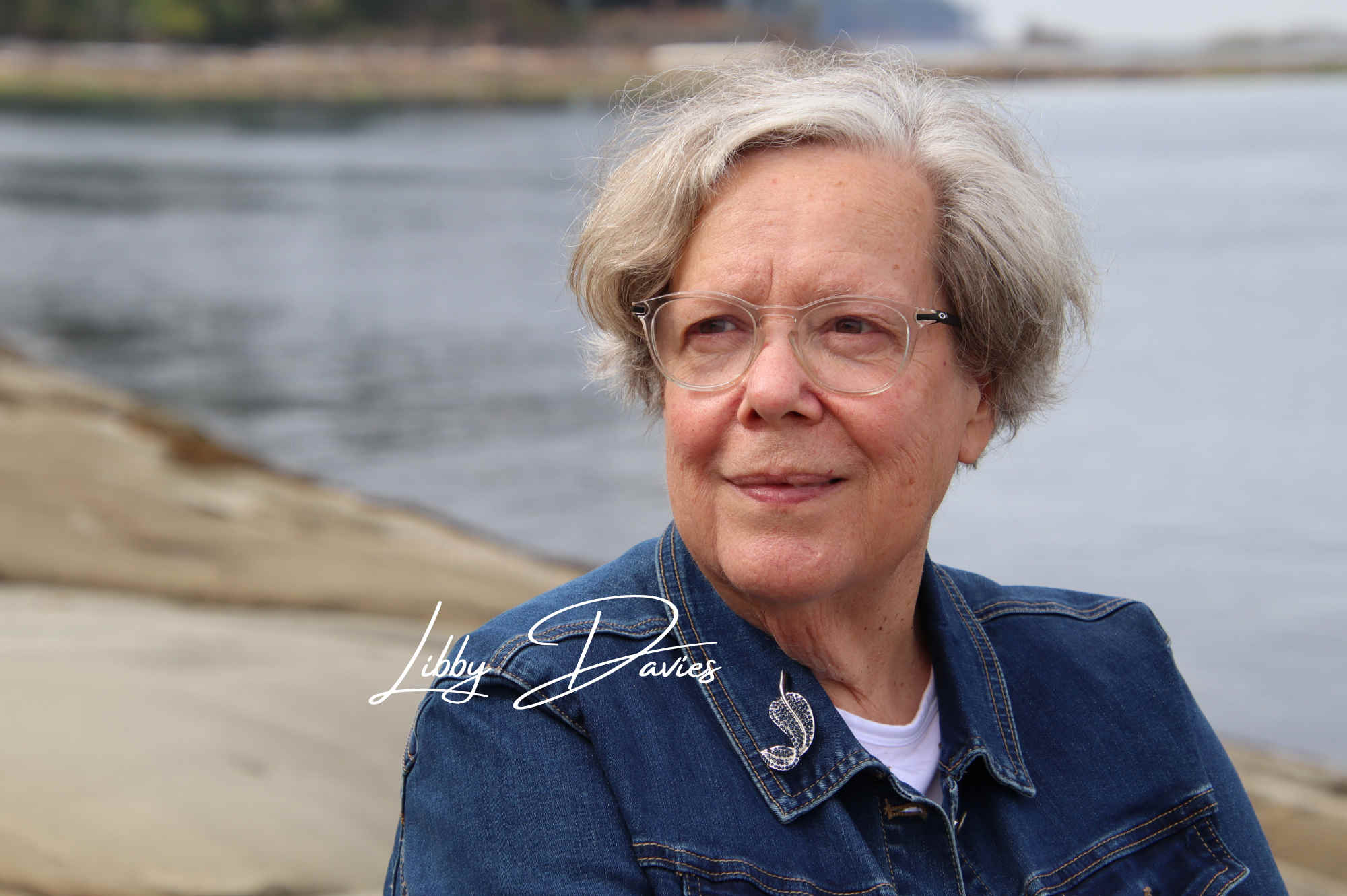
Libby speaking out against prorogation

Libby speaking out against prorogation

Prorogation means no Parliament on Monday, but that doesn't mean a reprieve from politics. There will be no official debates, no Question Period, no committee meetings, no discussion of consequence about Canada and its future. But there will be press conferences – a slew of them – as parties aim to seize political advantage while Parliament is suspended.


Libby’s speaks about federal action on chronic illness

Libby’s speaks about federal action on chronic illness

[[{“type”:”media”,”view_mode”:”media_large”,”fid”:”210″,”attributes”:{“alt”:””,”class”:”media-image”,”typeof”:”foaf:Image”}}]]

House of Commons

HANSARD

November 21, 2012

Libby Davies (Vancouver East, NDP):

Mr. Speaker, I move that the eighth report of the Standing Committee on Health presented on Friday, May 18, be concurred in.

I am pleased to rise in the House today to debate this report. I will be splitting my time with another member.

I do find it much more valuable that we are debating this important report from the Standing Committee on Health rather than yet another time allocation motion that the government tries to push on the House. We have now had 29 time allocation motions, in addition to two closure motions, as well as other motions that were simply designed to limit debate in this House.

I am happy today that at least we are debating a report of substance that has to do with chronic diseases related to aging, health promotion and disease prevention. The report comes from the Standing Committee on Health and was tabled in the House in May 2012. This is much more substantive work than trying to deal with yet another time allocation motion from the government.

The report we are debating today deals with the very serious issue in Canadian society of chronic diseases as they relate to aging and to old people. The Standing Committee on Health had a very fulsome debate on this. We heard from witnesses from October 2011 to February 2012. We heard very credible witnesses who told us that chronic diseases cost the Canadian economy about $190 billion annually. The committee was also told that the treatment of chronic diseases consumes 67% of all direct health care costs, which is a staggering figure. How often do we talk about this issue and consider what the cost considerations are?

We need to have a health care system that responds to people’s health care needs but there is now a growing body of evidence that tells us that we need to manage how the system works and we need to manage a lot better on disease prevention and health promotion. If we did those two simple things, we would save the system billions of dollars.

We need to focus better on primary care. We need to ensure that people have access to a family doctor through a community health centre. We need primary care that focuses on a multidisciplinary approach to prevent people from having to go to the emergency room and stand in line for hours and hours or go through procedures that might have been prevented if they had community accessible, community based health care based on health promotion and disease prevention.

The committee heard from a number of witnesses but the report that finally came out was somewhat disappointing. As we have seen with a number of committees, the government members did everything they could to write a report on a sort of A-plus on everything they believe the government has done, in many cases, ignoring what witnesses said in terms of what actually needed to be done to improve the system.

I am very proud that, in this particular report, the NDP members on the committee also submitted a minority report and put forward what we believe were the clear suggestions and recommendations that came from the witnesses we heard.

I will take this opportunity to go through some of those very important recommendations that we have put forward.

First and foremost, we have to go back to the 2004 health accords. These were accords that were signed by the provinces, the territories and the federal government and laid out a plan for 10 years about how we would approach our health care system. They built upon the royal commission that was conducted by Mr. Roy Romanow and his report of 2002 that was called, “Building on Values: The Future of Health Care in Canada“.

If we go back to the health accords in 2004, we see that there were some agreements. A consensus was arrived at by the provinces, the territories and the federal government on what needed to be done to refocus the priorities of our health care system and to ensure that we were getting health care services and support to people earlier, instead of waiting for the onset and management of chronic diseases.

One of Mr. Romanow’s key recommendations in 2002 was to have a home care program. As we can see today, many seniors who live alone and do not have the necessary support often end up in emergency rooms or in acute care when they should be getting community-based support and care, including home care. It seems to me that these are very logical provisions that should take place. It was very disappointing for us when participating in the committee and the report that was done to find that a number of these key recommendations were ignored by government members and it was up to us to bring them forward. It was key to actually go back to the Romanow report and look at what he had so soundly put forward about what needs to be done, a key one being home care.

Another issue that was clearly agreed to by the provinces and the territories was to implement a national pharmaceutical program. We know that many Canadians are finding the exorbitant cost of prescription drugs becoming very unaffordable for them. One of the key indicators of rising costs in our health care system is the cost of prescription drugs. It was interesting to note that, in the 2004 health accord, there was an agreement that this would be worked on and we would come forward with some kind of national program that would ensure that prescription drugs were affordable and accessible. One of the most obvious things that could have been done was to ensure that all levels of government worked together for a bulk purchasing plan for prescription drugs. It has been estimated that would save us about $10 billion annually in our health care costs. We are talking about very big numbers here.

This was a very key recommendation that the NDP put forward in this report on chronic diseases because we understand the need to address some of the inequities in the system and some of the incredible costs that people are facing, for example, with prescription drugs. It is something that needs to be worked on. It is an area of work where we have seen the federal government basically walk away. If we look at the agreements in the accords from 2004 and examine what has taken place since that time, the most obvious and glaring thing is the fact that the federal government has basically abandoned the recommendations and the agreements that were made in that accord. Is it any wonder that we are now facing higher and higher costs for chronic diseases because we are not paying attention to what it is that we need to do in our health care system and we are not paying attention to what was actually agreed to in 2004?

It has been very disappointing to see the failure of federal leadership in this field. Not only have the Conservatives not shown the leadership that is required on the accord, but then we had an incredible situation last year where the Minister of Finance unilaterally came out with a funding formula for health care that, as we know from the Parliamentary Budget Office, will shortchange the provinces and territories by over $30 billion in the long term. This is very shocking information. The fact that it was unilateral is usually a matter of discussion between the provinces, the territories and the federal government in terms of what those health transfers will be. The fact that the Minister of Finance made a unilateral decision and then the Minister of Health and the Conservative government as a whole basically said that it was not the federal government’s business, that it was up to the provinces to decide what do.

I want to be very clear in the House that we in the NDP understand that health care is a federal responsibility under the Canada Health Act. We understand that there has been a very strong role for the federal government. It is absolutely correct that the provinces deliver health care, but the role that the federal government plays in terms of transfers and of showing leadership to bring about agreements, such as we saw in the 2004 health accord, this has been a very important role for the federal government to play. The fact that now we have a Conservative government that has completely abandoned this responsibility presents us with a very serious situation.

I want to end by saying that one other area of the report that we highlighted was the lack of action by the federal government on the recommendations that came from the working group on sodium reduction. I want to mention this because it was really shocking to see that there had been an expert advisory group, the provinces and territories had even agreed and, lo and behold, it was the federal government that disbanded the group, moved away from the recommendations and basically abandoned its leadership.

I am very proud to say that we in the NDP have now tabled Bill C-460, which, if approved, would implement the sodium reduction strategy that was put forward in good faith and worked on for so many years. Again, this is a very critical issue around health promotion and disease prevention. It is an issue that affects those with chronic diseases. This was a very important recommendation in our report, which we will continue to work on.

Mr. Speaker, the NDP launched a national campaign in September of this year. We are now going across the country, consulting and speaking with Canadians in public health forums. We are holding expert stakeholder meetings. We have had an incredible response.

It is really quite ironic. We face a government that has refused to talk to Canadians about health care. It has walked away from the table. The government does not consider health care its responsibility, yet the response that we are getting out in local communities and in the polls from the Canadian Medical Association is that the number one issue for Canadians is for the federal government to take leadership on health care. The government is going in the complete opposite direction from what Canadians want. What we are hearing from Canadians when we go out in our public forums and talk with people is that this issue of drug costs and how high and unaffordable they are for so many people is something that is now very serious.

We even have situations where, for example, a cancer patient in New Brunswick who is paying an average of $60,000 for cancer drugs is being urged to move to British Columbia where those costs would be covered. We can see the inequities across the country. There are provinces that are working very hard, such as Nova Scotia and Manitoba, to deal with this but it is not within the framework of a national collaboration around drug costs.

The member is right when she raises this as a very specific question, because it is one of the key concerns that Canadians have. It is really very bothering to me that there is so much that the federal government could easily do from an economic point of view of saving billions of dollars and also from a social equity point of view in terms of making sure there are not these inequities in our health care system, yet the government has walked away.

The report that we are debating today is an opportunity for us to focus the limelight on these key questions and to make it clear that there is a progressive vision for health care in this country, and it is coming from the NDP.


B.C. to commemorate International Overdose Awareness Day with events in Vancouver and New Westminster – Libby Davies


B.C. to commemorate International Overdose Awareness Day with events in Vancouver and New Westminster

Speakers there are scheduled to include Nichola Hall of From Grief to Action, a group that was instrumental in Vancouver’s response to a spike in overdoses the city struggled with in the 1990s. Another is Darwin Fisher, who manages North America’s first sanctioned supervised-injection facility, Insite. A third is Libby Davies, who was an NDP MP representing Vancouver East for 18 years until 2015.


Outside In book tour is happening!

Outside In book tour is happening!

Very excited that the book tour for Outside In is about to begin – see the first leg of events listed below. It seems like it has been a very long journey of reflecting, writing, and going through the process of editing and publishing. But here we are!

I always wanted to write a book like this and many of the ideas and experiences of how change takes place have been rattling around my brain for years. I also learned a lot along the way, particularly reflecting on what happens to women in the political arena, and how sexism still pervades the political culture. This is something I feel I am only beginning to dig into.

I could not have gotten to where I am now with this book without the help and encouragement of many people, as reflected in the acknowledgement, but a special shout out to my partner Kim Elliott who has been there for me every step of the way, with patience and wisdom.

I hope you will join me at a book event in a city near you! So far we have events scheduled in the following cities:

Toronto, May 15

Vancouver, May 22

Winnipeg, May 27

Ottawa, May 29 and May 30

Hamilton, June 9

Mississauga, June 9

Libby

Hope to see you at one of the tour events and find what you think of Outside In. If you don’t see your city on the list and want to help organize something local, let me know!

Libby


Libby marks Mental Illness Awareness Week

Libby marks Mental Illness Awareness Week

[[{“type”:”media”,”view_mode”:”media_large”,”fid”:”200″,”attributes”:{“alt”:””,”class”:”media-image”,”typeof”:”foaf:Image”}}]]

House of Commons

HANSARD

October 2, 2012

Mr. Speaker,

This week marks the 20th anniversary of Mental Illness Awareness Week, organized by the Canadian Alliance on Mental Illness and Mental Health. Because of it, we hear the inspirational stories of Canadians living in recovery from mental illness. Mental Illness Awareness Week reaches out to organizations and people across Canada to raise awareness on the importance of mental health and the need for increased access to mental health services for all Canadians.

One in five Canadians experiences a mental health issue, so it remains a matter that touches us all. The recent Mental Health Strategy by the Mental Health Commission of Canada made very clear recommendations on what all levels of government must do, to address mental health, in a way that is comprehensive, accessible and forward looking. It is critically important that the federal government show leadership and implement the recommendations.

I hope all MPs will join in celebrating the courage and resilience of the six million Canadians living with mental illness.


2015 GRACE MACINNIS VISITING SCHOLAR lecture at SFU: Libby Davies “GRASSROOTS POLITICS IN PARLIAMENT

2015 GRACE MACINNIS VISITING SCHOLAR lecture at SFU: Libby Davies “GRASSROOTS POLITICS IN PARLIAMENT

In 2015 Libby gave the Grace MacInnis Visiting Scholar Lecture at Simon Fraser University.

See the video of the lecture here

The transcript was shared on the SFU Contours Journal – which you can read here.  It is also reproduced below. 

GRASSROOTS POLITICS IN PARLIAMENT

 I did not know Grace MacInnis personally but had a pivotal moment in my earlier years that was formative and very important to me. I did not know it then but like many things in life, you do not know at it the time, it is only later when you think back do you realize that it was a lesson learned.

            In 1972, at 19 years old, I first started in the Downtown Eastside by working in a low cost food store. That was a year before the Downtown Eastside Residents Association (DERA) started. At the time, this community we call the Downtown Eastside was called Skid Road, and it was an unknown area in Vancouver. It was not considered a neighbourhood. This place, the rooming houses in particular, was where the alcoholics, drunks, and down-and-outs hung out when they came into town from the lodging camps, mining sites, fishing boats, and so on. The Downtown Eastside, in this sense, was kind of like a non-entity. I got involved and started working with DERA in 1973 through a summer project called Opportunities for Youth. We started a newspaper called the Downtown East, which we delivered door to door in every hotel and rooming house. When I look at those old papers, which are all yellowed and torn, I think not only about how crazy the paper was, but also that it was a great tool for organizing.

            DERA had what was then considered a radical idea, that people who live in a neighbourhood have the right to be heard. With this aim, we started organizing, and it was like a union. My partner, Bruce Eriksen, is very much an influence in my life politically and otherwise. He lived in the neighbourhood and was integral to building the vision and idea of working with people on their rights, and more specifically, having people speak out for their rights through their own experiences. This is something that sounds very commonplace and easy today, but back then, unbelievably, it was considered radical because we were going up against all the norms, traditions, and power structures in Vancouver. DERA itself was a grassroots organization that had incredible influence on the politics of Vancouver civically; however, this is another story.

            When we were starting DERA, our first office was in the First United Church at Hastings and Gore. We had to fight tooth and nail for a big federal grant, and we used the media to embarrass the government until they gave it to us. When we finally received the grant, we moved to our new office, located on East Cordova at Princess Street. One day this young guy, Takeo Yamashiro, and his co-worker, Jun Hamada, walked in and told us that they were working with elderly Japanese seniors. These seniors were returning, after being evicted during the war, to the neighbourhood around Powell Street or what was then called Japan Town. We began to work with what became known as the Tonari Gumi. It was the connection with the Tonari Gumi and their drop-in centre that led me to first become acquainted with Grace MacInnis and her work.  I went to their events, and it was there I met Grace MacInnis. She was an absolute hero to them because they remembered that during the war she spoke out against the internment and segregation of Japanese Canadians. She spoke out against their property, fishing boats, stores, and businesses being stolen. At the time, that moment had such an impact because I remember meeting this woman, ever so briefly, never knowing, never dreaming that, like her, I would become a member of parliament 20 years later. She was a very remarkable woman.

            The topic I aim to explain today is grassroots politics in Parliament. I do want to say that I never planned on being elected. For some people, it is a career thing that they plot out by getting involved in the party and working their way up, but it was never like that for me. It was really more of an accident, and my experience in electoral politics came about because of my involvement as an activist in the Downtown Eastside. When I look back on those early years, from 1972 to 1982, we were fighting on all fronts, and we were fighting life and death issues. The issues that Grace MacInnis worked on are still some of the issues we work on today. This is because we meet obstacles as we make progress and we end up working on the same things as a result.

            In those early years, we were working on trying to force city council to enforce its own fire bylaws. People were dying in fires every year because the old rooming houses were like chimneystacks. They had open stairwells, single rooms, illegal wires going into the light bulbs, no way to cook, and all around deplorable conditions. We were loosing five to seven people a year in fires. I learned an important lesson working with DERA back then, which was that a large part of organizing and learning about people’s rights is actually understanding the law. There are laws that just sit in the books, but if they are not implemented, then they are useless. Our mission and campaign was to enforce these laws. It was very straightforward.

            In reaction to our attempts to enforce the fire bylaws, the slum landlords threatened to close down the rooming houses. They would argue that the rooming houses were not making them any money, and they would threaten us by stating that they were going to close down the hotels and throw people out. We then realized that all the beer parlours—there are many—were all categorized as “class-A beer parlours.” The old class-A liquor license states that rooms have to be attached to the beer parlour. Once we figured that out, we knew that they could not close down the rooming houses if they did not want to lose the beer parlour, which is where they made all their money. We had many campaigns to enforce the fire and the maintenance bylaws, to upgrade these buildings, and to maintain a very basic standard of living.

            These were very basic issues, and I can tell you that nobody trained us; it was totally by the seat of our pants. We alienated a lot of people, but we also had a lot of allies, and not just in the Downtown Eastside. It was a very interesting decade. We had periods where we were funded by the city. We got some money to hire organizers, but most of the time we shared a wage through unemployment insurance. We continued to battle with city hall and they did not want to fund us: we were too political. The reason I explain my involvement with DERA is because it is where my politics came from. My political views did not come from the NDP per se; they came from working in the community, learning how to be an organizer, and understanding what it means to be in alliance with people, which sometimes results in having enemies too.

            Soon after, I became a city councillor, which was also not something that was planned. I remember sitting in Harry Rankin’s living room in 1976 with COPE, and he pointed his finger at me and said, “you’re going to run.”  I did not dare say no. I remember being on my first media panel with Jack Webster and George Puil, and I was terrified. I was 23 with no training. It was terrifying to just get out there and do my thing, but somehow when you are young you just go out and do it, maybe because you do not know what the rules are.

            I certainty learned a lot both in the Downtown Eastside and being on city council. The political experience of being a city councillor is very hands on. It is a much more egalitarian process compared to the legislature or parliament. Everybody has a voice and you could get up and speak because there are not so many rules. However, what always fascinated me is the connection between social movement politics and electoral politics. As I became more involved in electoral politics, I was still very much connected to grassroots politics, community politics, and social movements, yet I could see the big disconnect between grassroots movements and parliamentary politics.

            Something that has always concerned me and what I think is a contributing factor to the disconnect between grassroots movements and parliamentary politics is that it is so easy for people to become cynical and to be turned off politics when we are continually fed the message that politics and politicians are simply self-serving. This is mostly by the media, who I think by and large have a vested interest in ensuring that average people do not vote. For example, recall Stephen Harper’s actions surrounding voter suppression, which bears striking similarity to what they did in the United States with the so-called “fair elections act.” I have always been concerned that there has been an undercurrent of disempowering people, and the poor and marginalized are most affected. The message perpetuated by the media reinforces the perception that nobody out there is really doing anything or cares about the public, especially the already marginalized, and this plays into fear and public cynicism. In contrast, if you are wealthy, you know your class interest and you do not even think about not voting.

            When I was running civically, Bruce and I used to top the polls in East Vancouver–– every bloody poll. People would cheer. Of course, voter turnout was only 30 percent in East Vancouver. In contrast, in the southwest corner of Vancouver, the voter turnout was 70 to 80 percent. George Puil was topping those polls. He was getting 3000 votes when we were getting 300. This is yet another outcome of an at-large system. It lead me to understand that even the notion of voting, which should be a basic democratic understanding and principle, is something that people have become very alienated from. It is partly their own experience that they are marginalized and feel unrepresented, but I think it is also a system of power and democratic practice. The media also contributes to this growing alienation, which seeks to silence people. The media reinforces the message that all politicians are the same: rotten. Of course there are people that are rotten and there are things that are thoroughly and fundamentally wrong, but if we walk away from it all we are giving more power to people who understand how to use it without blinking. We just give the powerful more of a voice.

            Social movement politics is very much alive in this country. I have watched it over forty years. Whether it is feminism, anti-racism, LGBT, or environmentalism, social movement politics is growing, and young people are engaged. But to make a connection from these social movements back to political parties and the electoral process is, for some people, a struggle. It is not like political parties and the electoral system are blameless. All political parties, including the NDP, want to win. As a result, these parties have to put all their effort into an election campaign. The challenge is to find a space in the middle and to figure out how to use our influence, our voice, and our experience in the electoral arena, and we have to make those connections back to the community so we can see the community as us and not as them.

            When I was elected in 1997, 18 years ago, there was a crisis beginning to unfold in the Downtown Eastside: people were dying of drug overdoes at an alarming rate. When I first started working in the neighbourhood, nobody was dying of overdoses. If there was an incident, it was very rare, but not hundreds or even thousands over the years. I was elected on 2 June 1997, and one of the first events I attended was an event in Oppenheimer Park. It was called One-Thousand Crosses, and was organized by the Portland Hotel Society and others. I remember walking from Main and Hastings, up Hastings Street, turning left, and going into Oppenheimer Park.

            This park, by the way, has its own interesting history. Oppenheimer Park is a very historic place when considering grassroots movements. It was called the Powell Street Grounds back then, and it was one of the main organizing venues during the 1930s for unemployed workers in the beginning of the On-to-Ottawa trek. I have a great book on the first woman city councillor, Helena Guttridge, who was elected in Vancouver in 1936. She was part of the Co-operative Commonwealth Federation (CCF) and was also a labour organizer for the labour council. There is a great picture of her, with her black hat, looking very severe and literally standing on a soapbox in Powell Street Grounds speaking to the unemployed.

            When I walked down these historic streets, I saw one thousand wooden crosses that had been put up in the park; each cross-signified the death of someone who had needlessly died from an overdose because the drugs that they were taking, either for self-medication or addiction issues, were illegal. Through the criminalization of addiction, people become victims because there are no regulations in place regarding the quality of the drugs. As result people were dying every day because the drugs in circulation were extremely harmful.

            In September, I went to Ottawa for the first day of Parliament and for the “speech from the throne.” I had no idea what this was. We all gathered in the House of Commons. It was a very beautiful place: a large room with huge stained glass windows. We were directed to walk down the hallway to the Senate, where we would hear the speech from the throne. I followed everybody out—all 300 of us. While walking down the hall, I noticed that the guy next to me was Allen Rock, the Minster of Health. I introduced myself to Mr. Rock, then told him about the alarming rates of drug overdoes in East Vancouver. I asked him if we could meet and attempt to rectify the crisis unfolding in the Downtown Eastside. He replied positively. I walked away feeling great about the fact that I had just met the Minister of Health, and he wanted to meet with me regarding this problem. I followed up, wrote emails, and phoned his office only to be told that the minister was busy. That went on for two months.

            So I thought: what will I do now? As a new MP, I was not really aware of the dynamics and processes of parliamentary politics, but I knew what I would have done if I was in the Downtown Eastside. So, I went down and sat in his office very politely. I said to the receptionist that I was Libby Davies, that I sent emails, letters, and calls requesting a meeting with the Minster, and that I was not leaving until I got an appointment. I also stated that I had all the media outside, but in actuality I had only one reporter from the Vancouver Sun who did a very good story. They looked at me apprehensively, but I was very polite. I have learned that when being confrontational, always be polite and smile. I sat there for a while, and finally they said, “Well Ms. Davies, we’ll be happy to give you an appointment on such and such a date.” That is how I got my meeting with Allen Rock. I started talking to him about what was happening in the Downtown Eastside, and he was interested but did not know anything about it. He had been the Minister of Justice, so he had a very justice-like lens on the issue. The objective was to move drug use away from a criminal justice issue, where you criminalize drug users, to a health issue. That was the big thing to move. I have been reading over some of my old letters to Allen Rock and all the other Ministers that followed him. My letters were especially intense when we were waiting for Health Canada’s response to establish INSITE.

            I was starting to learn my role, which was in part bringing activism into parliament. What I learned was that the better connection I had with people in the community, the better I understood what I needed to do. This was a very important lesson for me in parliament, because parliament is a long way away from people in the community. I have to confess that when I first started as an MP, I did not know what to do; no on tells you what to do or how to go about doing the work. All I was really aware of was that I was an MP, in a party and a caucus, and that within these arenas there were all these rules, and it was extremely hierarchical to the extent that members are told when to speak. How was I to accomplish what I believed I was meant to do? I really struggled with this. Svend Robinson helped me a lot. He has been an MP since about 1979. I figured out that what drove me was what was going on in the Downtown Eastside, and I was always moving forward as long as I could keep that in my head and keep those connections. I learned—and this is unfortunately the bad side to politics—it is kind of easy to get sucked in. Ottawa is a beautiful city, but Parliament Hill is a very weird place. It is in its own little world, like a bubble, and in there it is all about who knows who and the politics of what is going on. It is important to keep focused on the reasons for being there, the people you represent, and what needs to be done. At that point, the NDP caucus was quite small, and Alexa McDonough was the leader. I was fortunate that they left me more or less alone because I was from the west coast. Within this context, I realized that I just had to get on and do what I believe needed to be done.

            The reason I had decided to run was because of housing. I was so angry that Paul Martin had dismantled the national housing program that we had in 1995. He literally dealt with the deficit on the backs of poor people. He is now lorded as this great Finance Minister who eliminated the deficit, but he accomplished this by slashing the social and health transfers, and ultimately cutting out Canada’s housing program. I had been a city councillor who saw the incredible value of those housing programs here in Vancouver that resulted in the development of Co-ops and social housing. When I was in city council we used city land, long-term leases, and federal mortgages to develop social housing. All that came to a crashing halt. When I started working on the Downtown Eastside, homelessness was not to the extent that you see today. People were poor, but they still had enough money to go to the Ovaltine Cafe and buy a coffee once in awhile. It was not like how it is now where people are destitute because welfare rates are frozen and housing has not kept pace with gentrification. These are still huge issues today.

            I decided to do a national tour across the country on housing. I have to admit that I was a little bit arrogant because I was from the east side and thought I knew it all. I thought I knew a lot about housing because I had worked in the Downtown Eastside for a decade and I had been in every rooming house and filthy place. I went across the country and up north into small remote communities where I saw Aboriginal people living in houses that have been built by CMHC, and you could see the spaces between the planks in the wall. They had no plumbing, water, or electricity. I was stunned. At that time, there was also the homelessness crisis in Toronto. The Toronto Disaster Relief Committee was formed, and they called it the unnatural disaster of homelessness because people were dying in the streets. I went across the country and produced a report, and I became part of a movement to pressure the Liberal government who would never admit, by the way, the catastrophe of their decision to eliminate social housing. What the federal Liberal government did was appoint Claudette Bradshaw as homelessness minster, and I will give her the credit for providing the money for shelters. It was the only way the Liberal government could justify their decision to cut funding to social housing and win back community confidence. Becoming part of a movement that pressured the Liberal government on social housing was one of the first things I did in 1998 and again in 2001.

            I would like to share some lessons I learned while being in politics over the years. I have learned that there is a role inside and outside the party. Of course, a lot of people would not see what goes on inside, and I learned very quickly that the politics inside, in some ways, are more important than what goes on outside. The internal influence, and the use of that influence is critically important. This is a facet of politics that most people do not see because it is secret; caucus meetings are in camera, and they have to be. However, it is difficult to navigate grassroots politics within internal caucus politics. For example, there are instances where you may not agree with what is going on around you. At this point, you have to ask yourself how to best proceed and to reconcile the urge to speak and the overall well-being and reputation of the party and your colleagues. I can speak on many different issues where I had that experience, and this is probably the hardest aspect of politics that I have learned. In activism, activists are able to go for it all, and if you do not want to compromise, then you do not have to. However, in a political party and a political caucus, there are compromises and differences that have to evolve constructively. You need to know how to live within this context or to get out if it is not something you can stand. I felt that I could be a voice both externally but also internally within the party.

            One of the more interesting things I did was organize and conduct citizen weapon inspections in the US. This occurred when the weapons of mass destruction in about 2002 to 2003 were discussed, and Bush was just whipping up the frenzy about weapons of mass destruction in Iraq. Steve Staples, a great activist in Vancouver then Ottawa, came up with this fantastic idea of doing citizen weapon inspections in the United States, where the most weapons of mass destruction reside. So, we organized this little team, hired a small airplane, and flew over Bangor, Washington, where all the nuclear subs and the cruise missiles are. They would have shot us down today. We initially had clearance to visit the US Navy Pacific Command base, but as we were driving down Highway 5 to Seattle, they revoked our clearance and said we could not go into the base. So we decided to take this little airplane to conduct our own inspection for weapons. We even had blue hats on like the UN inspectors. We got this huge amount of media, which was mostly terrible because people were really angry. We had touched a nerve. This is where I learned another very important lesson: when doing something controversial and in your face, you have to be very low-key about it. When we showed up at the base, they were all in uniform, and all the higher-ups were standing there. I think they were expecting us to climb the fence. I was the spokesperson because I was the only MP. So, I put on my best smile and said, “We are here to do weapons inspection. Could we come in please?” They looked at us like we were crazy, yet we remained very polite. We knew that they were going to say no, but we made our point. We did it twice after that. We went to two places in Washington to do the same thing, and it was again very controversial. Part of my role as an MP was working within the party, and part of the role was also using my position as an elected member to work with people to get their message out. I felt that I could use my voice and credibility because I knew I was working with people that I trusted. But you have to be careful about the way you go about it. I was very fortunate that the leader at the time, Jack Layton, was wonderful and supportive, and he gave his consent for me to participate in the citizen weapons inspections. However, you can get mixed up in crazy stuff. You may find out that you have been used. You have to be smart about it.

            Being in the caucus while keeping connections to the community is a very important part of what I do in terms of grassroots politics in parliament. Building relationships is fundamental in whatever work you do. What I learned in politics is that, if you are honest and straightforward with people even when they do not agree with you, they will trust you and give you space to work. When I first got elected I started by working on the controversial issue of drug use, which was then governed by the politics of fear. Law and order prevailed through the images of drug deals in schools, and the “Harperites” excelled at reinforcing this image and subsequent retributive response. To increase police presence and implement rigid law and order is a traditional response. To go against that, which is not so difficult now, was not a very popular stance back then. I had people in my own campaign saying that I would never get re-elected. I actually did think about that, and I decided if that was to be, then that was to be. But I think that even when it was controversial and there were people yelling and writing nasty emails, it was the relationships that I built with people that continued to give me some space to work.

            Another important thing to do is work in alliance with groups. One particular group that I want to mention is the Vancouver Area Network of Drug Users (VANDU), which first emerged in 1998. Working with VANDU was a pivotal moment for me in terms of hearing directly from drug users, who were my constituents, about their experience. Hearing these experiences gave me the fortitude to go into those other arenas and speak truth to power. This is what bringing grassroots into politics is all about: bringing the voice of the community into politics and having their experiences inform policy

            A lesson on building support within the party is exemplified in one of the issues I worked on over the years: the missing and murdered women. My first interaction with this issue was in the early 1990s, and Margret Mitchell was still the MP. A woman’s body had been found in the dumpster on Dundas Street. In an attempt to establish awareness we gathered at that dumpster and marched down to the Carnegie Center where there was a smudge ceremony. She was an Aboriginal woman from Sechelt, and her family came down. It was the first time in the community that there was public acknowledgment that sex workers were going missing and were probably murdered. We began calling for a police investigation on a serial murderer, but the police dismissed it. If these were students or nurses, there would have been an outcry, but because they were sex workers and Aboriginal, it was like they did not exist. They were missing people.

            When I started working on the issue of the decriminalization of sex workers within the NDP, it was very controversial. People did not want to deal with this problem because it was not exactly a mainstream issue, and it was not very popular when I started talking about the need to decriminalize sex workers. This was another lesson in how to work internally and not necessarily fight the party but find ways to bring the issue forward. We were confronted by such internal political disagreement as recently as the last NDP convention in 2013, when we drafted a resolution, put it to the floor, and then learned that it was going to be defeated because there was opposition––it is a highly contentious issue. There are some folks that do not support decriminalization, and I recognize that as a controversial issue. So, we faced the possibility of the resolution being defeated. As a result, we decided to withdraw and refer the resolution to what is called the federal council, which is the governing body of the NDP between conventions. We re-drafted the resolution, taking into account some of the concerns that were made, and then we took it back to the federal council where it was passed unanimously. This is because we talked to people, worked with our Aboriginal commission, spoke with our women’s commission,  consulted with our justice critic, and crafted the language. I use this as an example to show that we all have different roles. I am believer of rallying on the streets with large demonstrations, but there are these other elements that, unless you have them all together, unless you are working at every level, you are not necessarily going to be successful.

            In addition to reconciling the voices and influences within and outside the party, I have also learned that it is important to understand how to implement the rules within the parliamentary process. If you are going to be a successful parliamentarian and you want to get your controversial grassroots issues in, you need to know how to use the rules. I am still learning. As recently as last December, we learned about the issue surrounding the thalidomide survivors.  These are people whose mothers had taken the thalidomide drug, and they suffered terrible deformities and health conditions. They had been trying to get the Minister of Health to provide compensation, but the Minster of Health did not reply to them. The lack of attention by the Minister came to my attention, and I was the health critic for the NDP at that time. We could have gone two ways on this issue: we could have blasted the government and made a big political issue or we could have worked within the parliamentarian structure. I decided we needed to find a way to get the resolution through parliament in a unanimous motion. The first thing we needed to do was set the stage within our own party to get us to agree and to follow the necessary procedures needed to develop the motion, because we have only certain days where we can bring a motion forward. We did that. Then I lobbied the Minster of Health and reinforced that we wanted to work with the Minister on the language with the hope of getting this motion through. The Minster was open to the suggestion, and we got the motion through, resulting in a settlement for those afflicted with thalidomide-related suffering. This is an example of how members of parliament can work individually as MPs along with their colleagues elsewhere in the system to get something done.

            A lot of work that I have done in parliament on the outside has been lobbying. I lobby the ministers all the time. What I learned in my experience as a member of parliament is that most people have very little interaction with the people in the system, and do not know how it works. Over the years, I have done a lot of lobbying workshops for community organizations to talk about the process and effectiveness of lobbying. I think there is this myth that politics is static or immovable, especially if you are dealing with a conservative government. That is not true. Politics is dynamic, it is always changing, and public opinion does play a role. Mobilizing is done on the street, but influencing members of parliament can also happen with lobbying.

            One of the groups that I did some work with was Students for a Sensible Drug Policy. They came to Parliament Hill for several years. We would do our workshops, and they would speak with the MPs afterward. They would talk about their own experience as students with drug policy and why criminalization of young people for drug use was ridiculous. It was their voice, which was so important. A pivotal thing that I learned was that, whether it was the voice of drug users, VANDU, students, sex workers, or people who are homeless, their voice gets carried forward when people learn how to use the processes and laws. Only through learning not to be intimidated by the political processes can you lobby members of parliament, develop relationships, and persuade change.

            Finally, life after politics for me likely means more politics but in a different role. One of the most important things I want to do is to encourage young people to run. I had the wonderful experience of being with the NDP caucus from 2011, many of whom were under thirty. I feel angry today when I remember how the media trashed these young folks for being elected. For many of them, election to office was a jump into the deep end and then learning how to swim. The first challenge they met was the “back to work” legislation for the postal workers. We had forty-eight hours of non-stop debate in the house, and I watched these young people as everything unfolded. The youngest was 19, who later became the chair of the ethics committee. The opposition is usually the chair of the ethics committee, and Thomas Muclair knew that this kid was bright, so he made him the chair. I watched this young caucus at 3 am, and they were all on their computers in the lobby writing their speeches and doing their research about Canada Post and “back to work” legislation. I thought, “wow,” this is going to be a really remarkable caucus; they are up for it. I was very inspired by that caucus from 2011.

            I hope we can move beyond the cynicism that continues to alienate people. The 2015 federal election is a historical election, and I am not being partisan here. Have your own political opinions, and I will have mine. As we examine the direction this country has been going, I would like to reinforce that we have an opportunity to change the direction and to be part of that change. This comes full circle to my main message: grassroots politics in parliament is really about reaching out, making connections, and forming policy that reconciles community experience with the political process. This is not achieved by forcing people to vote—that does not work. Voting is an outcome. Voting is only the outcome of people who feel a vested interest and a belief that their vote can count for something. I hope as I continue my political life in whatever way that I will also continue to build trust with people and the activism we need. I want us to move beyond cynicism and to empower the voice of people to become engaged in the political process in whatever way. I want to help people understand that they can influence and change the outcome of what happens.


Top